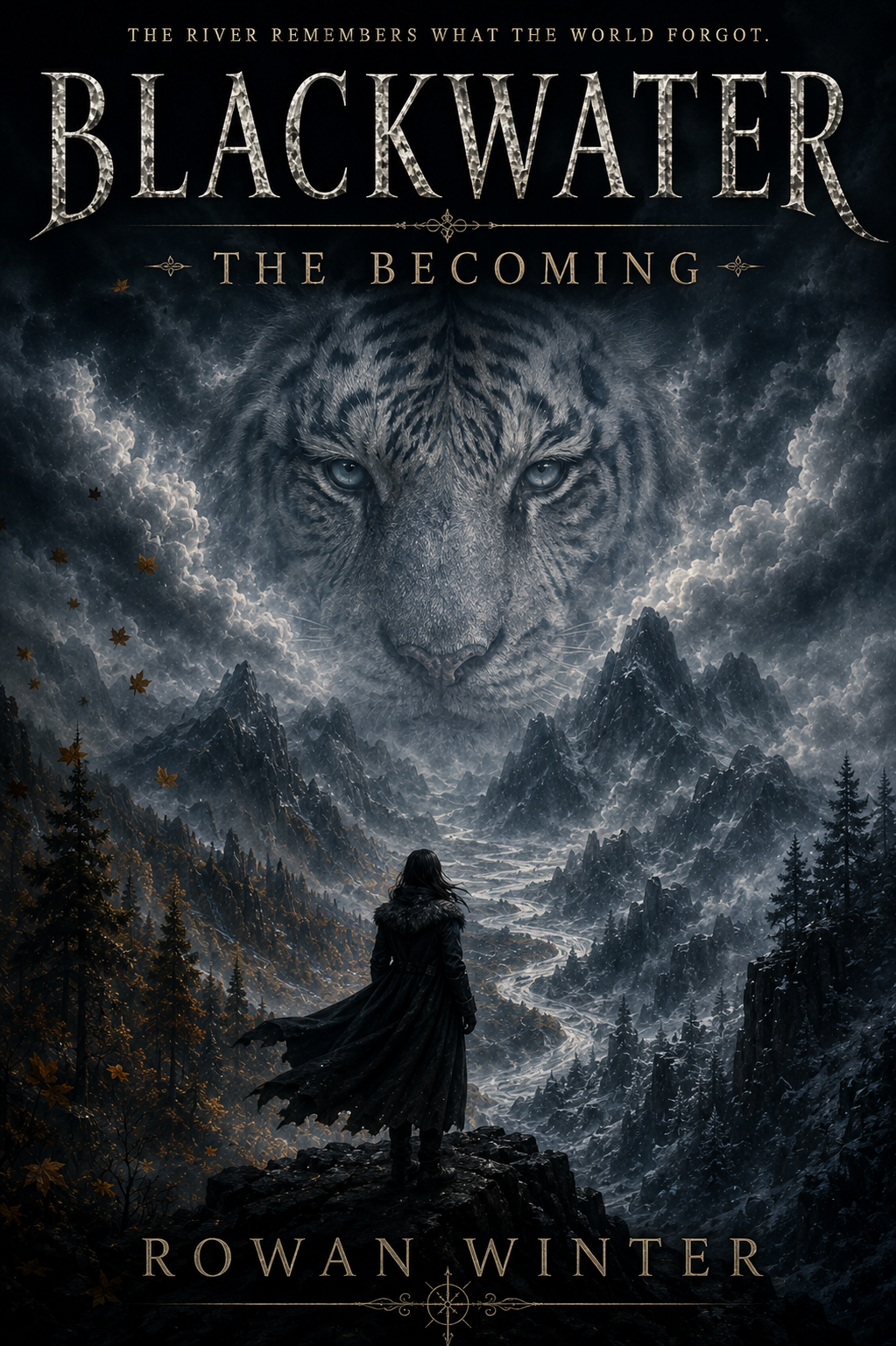
The Blackwater Series · Book Four
The Becoming
Available NowThe panther was only the beginning.
The bloodline goes deeper than anyone knew.
The Blackwater Series · Book Four
The panther was only the beginning.
The bloodline goes deeper than anyone knew.
What's Coming
THE WAR IS OVER. THE BECOMING HAS ONLY JUST BEGUN.
The Yaguareté-negro was not the end. It was an introduction. A test run. An old intelligence taking the measure of what Alyssa Kincaid-Waters had made of the hunger it lent her — and deciding she was ready for the next level of the bloodline's inheritance.
Something white moves at the edge of the territory. Not the void. Not the encantado. Something that has no name in Blackfoot or English or Portuguese, because it has never had to give its name before. Something that does not hunt. Something that waits — and has been waiting, with the patience of a thing that measures time in centuries, for the bloodline to produce a vessel strong enough to hold it.
Alyssa has fought for her territory, her circle, her bloodline, her chosen. She has held the hunger and transformed it and made it part of herself. She has woken twelve women across twelve cities and built a network that spans the globe. She has faced the deep origin and made it reckon with what she became.
She thought that was the end of the becoming.
She was wrong.
The Becoming is the fourth book in the Blackwater Series — available now.
The Blackwater Series
The Series So Far
Start from the beginning. The Fever is Book One.
Book One
The Fever
Available NowBook Two
Bloodlines
Available NowBook Three
The Deep
Available NowBook Four
The Becoming
Available NowStay Connected
Follow along for what's coming next in the Blackwater Series:
Free Sample
Free First Chapter
The decision came in August, six years after the attack that had made her something other than human. The network was running itself now—Sarah's research infrastructure, Aila's goabddát holding the northern thresholds, Amara's Ìsọ̀kan flowing through West African currents. Six months ago, at the solstice, a girl named Nia had spoken her first yes on Chief Mountain, and the already-cracked stone had trembled but held under the weight of it. The mountain had become the circle's convergence site now, the place where all bloodlines came to choose, not only the Waters line. The Yaguareté-negro remained at the mountain, diminished but present, the first student still learning what it meant to belong rather than to make.
Alyssa stood in the clinic's surgery, the same room where she had first shifted fully, where the panther had risen to meet the Rottweiler's submission. The room smelled of antiseptic and predator and the particular warmth that her skin radiated now, the constant fever that had become her baseline, the jungle heat she carried inside her even in Montana's dry summers.
Ethan found her there at 3 AM, when the global circle's voices had gone quiet across time zones.
"You're leaving," he said. Not a question.
"The Yaguareté-negro is dying," she said. The words came out flat, clinical, the veterinarian's assessment of a patient she could not treat. "Not its body. Its pattern. The void's attack six years ago damaged something that isn't tissue, isn't cell, isn't anything the network's medicine can name. Josephine says the primal maker is fading. The damage was slower than we thought, but it's accelerating now. The first maker of choosers is coming apart at the level of pattern itself."
"The bloodline ends."
"Or changes into something we can't predict." She turned from the surgical table, the stainless steel reflecting her eyes—gold, always gold now, the integration so complete that the human and panther were indistinguishable even in reflection. "The Yaguareté-negro was the first to make choosers. But it was made too. Something made it. Something that Carlos knew. Something that the Amazon still holds."
Ethan was silent. The soldier's discipline, the chosen's patience, the man who had learned that the war was not about killing but about holding. He reached for his rifle, the reflex that had become instinct—not to stop her, but because the chosen's instinct was always to stand between those he loved and whatever they faced.
"Not this time," she said. Her hand on his wrist, the heat of her skin against his, the claim that was also permission. "The void is quiet. The network is strong. The circle is whole. And this isn't a mission, Ethan. It's a pilgrimage. The thing that made me is dying where it was made. I need to go alone. I need to walk back through the fever and the blood and the jungle heat and understand what I became. What we all became. What the primal maker was before it made anything."
"Alone," he repeated. The word carried weight, the history of every time she had left him behind, every time he had stood at thresholds and watched her cross, every time the chosen's patience had been tested by the guardian's solitary nature.
"Not alone." She brought his hand to her chest, the panther's purr vibrating beneath his palm, the sound that was invitation, not demand. "You're in my blood. The circle is in my blood. The network is in my blood. I carry the goabddát and the Ìsọ̀kan and the first chooser's yes and Nia's future. I don't travel alone anymore. I just travel without company."
He looked at her for a long moment, the dark eyes reading what she had not said, what she could not say, what the panther knew in instinct and the human was still learning in language. "The Yaguareté-negro is the primal maker," he said slowly. "The first to make choosers. But it was made too." He paused, the recognition settling. "Something that the encantado names."
"Something that the encantado names," she finished. "Yes. That's what I'm going back to find. Not the attack. Not the fever. The before. The making of the making. The wound that existed before it ever touched me."
They stood in the surgery until dawn, not speaking, the chosen's hand on the guardian's chest, the panther's purr filling the space between them with vibration that needed no translation. When the light came through the window, Alyssa kissed him—not the bite of the kitchen, not the blood on the lip, not the territorial mark, but the kiss of a woman who had learned to ask and was now asking him to let her go.
"I'll come back," she said.
"I know," he said. "That's why I can let you go."
She flew to Manaus on a Tuesday, the same route she had taken six years ago when she was still Dr. Alyssa Kincaid-Waters, veterinarian, former Marine, a woman who had survived worse than a jungle cat and did not yet know she was becoming one. The flight was different now. The fever made the pressurized cabin feel like a cage, the recycled air wrong against her skin, the human proximity too close, too loud in ways that her expanded senses could not filter.
In Miami, she changed planes and walked the terminal, the panther's senses reading the crowd—heartbeats, sweat, the chemical signatures of fear and excitement that humans emitted without knowing. She found a corner near the international gates and sat with her back to the wall, the soldier's discipline, the predator's patience.
A woman sat across from her. Young, maybe twenty-five, dark hair, the cheekbones that Alyssa had learned to recognize—the bone structure that carried guardian potential, the bloodline's signature that was not genetic but something older. The woman's eyes were brown, human, unaware. But the fever in her skin was visible to Alyssa's senses, the low-grade heat that was not illness but awakening.
Alyssa looked away. The network's protocol—find the carriers, protect the dormant, offer the choice when the time is right. But she was not on network business. She was on pilgrimage.
The woman looked at her. Not staring, but sensing something—the heat radiating from Alyssa's skin, the gold in her eyes that she kept lowered, the predator's presence that pressed against the edges of human perception like a weight in still water.
"You're warm," the woman said. The voice was accented, Brazilian, the English careful. "The air conditioning is very cold. But you don't shiver."
"The jungle," Alyssa said, not looking up. "I grew up in hot places. Cold doesn't reach me anymore."
"I am from São Paulo. But I am going to Manaus. For research. I am a biologist. I study river dolphins."
Alyssa felt the words land in her chest. River dolphins. The encantado. The boto cor-de-rosa, the pink river dolphin, was one of them. A guardian tradition. A bloodline that the network had not yet reached.
She reached into her pocket and found a card—network protocol, the coded contact that Sarah had designed. She pressed it into the woman's hand.
"When you're ready to understand what you're becoming," she said, "call. Not yet. But when the day comes, you're not alone."
The woman looked at the card, then at Alyssa, the brown eyes flickering with something that was not yet amber but was closer than it had been. "What are you?"
"Someone who went back to the river," Alyssa said. "Someone who found what the water holds. Someone who came back to tell you that the dreams are real, and that real doesn't mean safe, and that safe is not the point."
The boarding call came. Alyssa stood, the loping stride that had become her natural movement, and walked toward the gate without looking back.
The plane to Manaus was smaller, the cabin closer, the jungle pressing against the windows before they even landed. Alyssa sat by the emergency exit, the soldier's discipline, the predator's assessment of exits and angles and the water that waited below.
Manaus had changed in six years. The airport was larger, the traffic denser, the humidity more intense—the climate's acceleration, the jungle's revenge against the human world that had tried to contain it. Alyssa walked through the terminal with her single bag, the military habit of traveling light.
The heat hit her like a welcome. The fever that she carried inside her found its match in the Amazon's wet air. For the first time since leaving Montana, she felt temperature-symmetry, the external world aligning with her internal one. She stood in the taxi line and let the sweat come, let the pores open, let the panther's metabolism find its natural rhythm in the climate that had made it.
The taxi driver was old, indigenous features mixed with Portuguese colonial, the face that had seen generations of outsiders come to the jungle seeking something they couldn't name. He looked at her in the rearview mirror and his eyes narrowed.
"You are not a tourist," he said.
"No."
"You are not a scientist."
"No."
He was silent, navigating the traffic that swarmed around the airport. "Then you are a hunter," he said. "Or you are hunted. In the Amazon, there is no third choice."
"Both," Alyssa said. The voice was low, the panther's register, the gold in her eyes catching the afternoon light. "I was hunted here. I became the hunter. Now I'm going back to find what made the thing that made me."
The driver's hands tightened on the wheel. "The encantado," he whispered. "You speak of the encantado."
"I speak of what the word means. Not the stories. The real thing. The thing that wears shape the way I wear shape. The thing that made the thing that made me."
He pulled over. Not at her hotel, just stopped the car in the flow of traffic and turned to face her. Something moved behind his eyes—ancestral memory, the blood's whisper.
"My grandmother spoke of them," he said. "The boto that walks. The jaguar that thinks. She said they were guardians of the river, of the boundary between what is known and what is hidden." He paused, his voice dropping. "She also said they were dying. That the river was changing. That something in the old places was wrong. The places where the water goes deep, where the sun has never reached."
"The old places," Alyssa repeated. "Where the river runs underground."
"The locals call them igarapés," the driver said. "The small streams. But my grandmother had another word. From before the Portuguese. Before the Tupi." He struggled with the phonetics, the syllables unfamiliar on his modern tongue. "She called them the boca do rio verdadeiro. The true river's mouth. Not where the river meets the sea. Where the river meets itself. Where the surface water meets the water that has never seen light."
Alyssa felt the words in her teeth, the bloodline's recognition of something the network had not yet mapped.
He drove her to a hotel near the port, a place where the river's smell dominated everything—the rot and bloom and too-alive green that Alyssa remembered. He refused extra payment, refused her offer of the network's contact card. He just looked at her as she stepped from the car.
"Be careful, hunter," he said. "The boca do rio verdadeiro is not a place. It is a choice. The river offers it to those who have already chosen once. To go deeper is to choose again. And the second choice is not like the first. The first is made in ignorance. The second is made in knowing. And knowing changes what you become."
She watched him drive away. The hotel was simple, clean, anonymous—the kind of place where a solitary woman would not be noticed, where a predator could rest before the hunt.
She slept without dreaming, the panther's rest that was not sleep but simply absence, the integration so complete that the boundary between waking and sleeping had dissolved. She did not need the dream-bridge anymore; the panther was already her, and there was nothing left to bridge.
At 3 AM, she woke to the smell of water. Not the hotel's plumbing, not the river's distant presence, but something closer, something that had found her window. She rose and went to the glass and looked down at the street, empty except for the heat shimmer, the humidity that made the air visible.
And in the shimmer, she saw a shape. Not a dolphin, not a jaguar, not anything that had a name in English or Portuguese. Something that was all of these and none, something that wore the water the way she wore the panther, something that looked up at her window with eyes that were not eyes but simply the river's own gaze.
It did not speak. It did not need to. The message was in the watching, in the waiting, in the recognition that passed between them—not predator and prey, not guardian and guardian, but something older.
The shape dissolved into the shimmer. But the watching remained. The river had found her. The deep place was waiting.
Morning came with the Amazon's violence, the sun rising suddenly, the heat building exponentially, the day arriving as a fact rather than a transition. Alyssa dressed in the clothes she had brought—lightweight, quick-dry, the military gear adapted for jungle conditions.
She walked to the port, the river's presence growing with each block, the smell of water and rot and life that was too alive to be clean.
The research station was gone. She found the location by memory, the dock where the boat had waited, the platform where she had stumbled with the fever burning, where the jungle had first breathed against her skin and she had not understood that the breath was greeting. Dr. Chen had published the official account and moved on years ago; the station had changed directors twice since, each one less willing to acknowledge what the first expedition had found.
In its place was a new structure, larger, more permanent, the sign of a research institute that had expanded, that had continued the work of cataloging what the jungle refused to explain. She stood at the dock and looked at the water, the brown current that moved with the weight of sediment and history.
"Dr. Kincaid-Waters?"
The voice was young, American, the accent of a graduate student who had found her name in old files, in the records of the attack that had been classified, buried.
She turned. The speaker was a woman in her late twenties, blonde hair pulled back, the uniform of field biology—khaki shorts, moisture-wicking shirt, boots that had seen use. She held a tablet, the screen showing something Alyssa couldn't read.
"I'm Dr. Emily Vance," the woman said, extending her hand. "I'm the station director. I was reviewing our historical records and—I have to say, I didn't expect to find you here. Your file says you were medically evacuated, that you never returned, that the attack was—"
"Classified," Alyssa finished. She took the hand, the heat of her skin against the woman's cooler one, the predator's senses reading the heartbeat, the respiration, the chemical signature of someone who was nervous but not afraid. "The attack was classified. I was evacuated. I never returned. Until now."
Dr. Vance looked at her with the eyes of a scientist who had found an anomaly in her data. "Your medical records are sealed. But I found the photographs. The wound patterns. The things that don't match any known predator. We've had other incidents since then. Other attacks. Other researchers who went into the northern quadrant and came back changed, or didn't come back at all. The pattern is—"
"Not your science," Alyssa said. The voice was low, the panther's register, the gold in her eyes catching the morning light. "I know what you're trying to study. And I'm telling you, as someone who was there, who became what your science can't measure—stop. Stop sending people into the northern quadrant. The thing that attacked me is not an animal. It's not a disease. It's older than your discipline. And it's dying."
Dr. Vance's hand tightened on the tablet. "Dying? How do you know it's dying? What do you know that we don't?"
Alyssa looked at the water. "Because I carry it," she said. "Because I am what it made, and I can feel the making unraveling. Because the Yaguareté-negro is the primal maker—the first to make choosers—and it is fading. When it dies, everything it made changes. The bloodline I've built, the network I've connected, the guardians I've gathered across the world—we're all tied to the source. And the source is going back to the water. Back to the deep place. Back to where the river meets itself."
She turned back to the scientist, the gold eyes steady. "I'm not here to help your research. I'm here to do what I should have done six years ago. I'm going to find the source. I'm going to understand the making. And I'm going to decide whether the bloodline I've built can survive the death of what started it."
Dr. Vance was silent. The tablet's screen went dark, the automatic timeout. "The northern quadrant is restricted," she finally said. "Government order. No one goes in without authorization."
"I don't need authorization," Alyssa said. "I need a boat. And I need someone who knows the igarapés, the small streams, the places where the river goes deep. Not a scientist. Someone who speaks the river's older language. Someone who knows the word encantado and doesn't use it for tourists."
Dr. Vance looked at her for a long moment. Then she reached into her pocket and withdrew a small object—a carved stone, shaped like a dolphin, worn smooth by handling. She turned it over in her fingers, not quite showing it to Alyssa, but not hiding it either.
"I found this," she said, her voice lower, "in the northern quadrant, three months ago. It was on a tree branch, ten meters above the water line. No tool marks. No explanation. I didn't put it in my report." She paused, her jaw tightening. "And there was the sound. Three nights I camped in the quadrant, and every night I heard something moving in the water that wasn't fish, wasn't dolphin, wasn't anything with a name in my field guides. It circled my camp. It never came close enough to see. But I felt it watching. I felt it waiting for something." She looked up, meeting Alyssa's eyes. "I know someone. His name is João. He's a paje's apprentice. He knows the river in ways that our hydrographic maps don't capture. But he doesn't work for money."
"For meaning," Alyssa finished. "For the connection to what the modern world has forgotten. I know the type."
Dr. Vance slipped the stone back into her pocket. "I'll take you to him. But I'm coming with you to the northern quadrant. I need to know what I found."
"The river doesn't care about your research," Alyssa said.
Dr. Vance looked at the stone in her pocket, then at the water, then back at Alyssa. She opened her mouth, closed it. Ten years of empirical methodology, of peer review, of hypotheses and controls and reproducible results, pressed against what she had heard in the dark, what she had felt watching her camp, what she held in her pocket, what the woman with gold eyes was telling her.
"I've spent ten years," she said, "building a career on what can be measured. What can be replicated. What can be published." She stopped. The water moved against the dock, the brown current carrying its weight of sediment and history. "No. Not anymore. I'm not going for research. I'm going because I found something that shouldn't exist, and I need to know if I'm losing my mind or if the world is larger than I thought."
Alyssa nodded, the predator's assessment of a new variable in the hunt. "Then we leave at dawn."
She walked back along the dock, the feline rhythm that had become her natural movement, the heat radiating from her skin in waves that the humidity caught and held. Behind her, Dr. Vance stood with her darkened tablet, watching the anomaly walk away.
The river waited. The deep place was closer. And the second choice, the choice made in knowing, was about to begin.
The Author
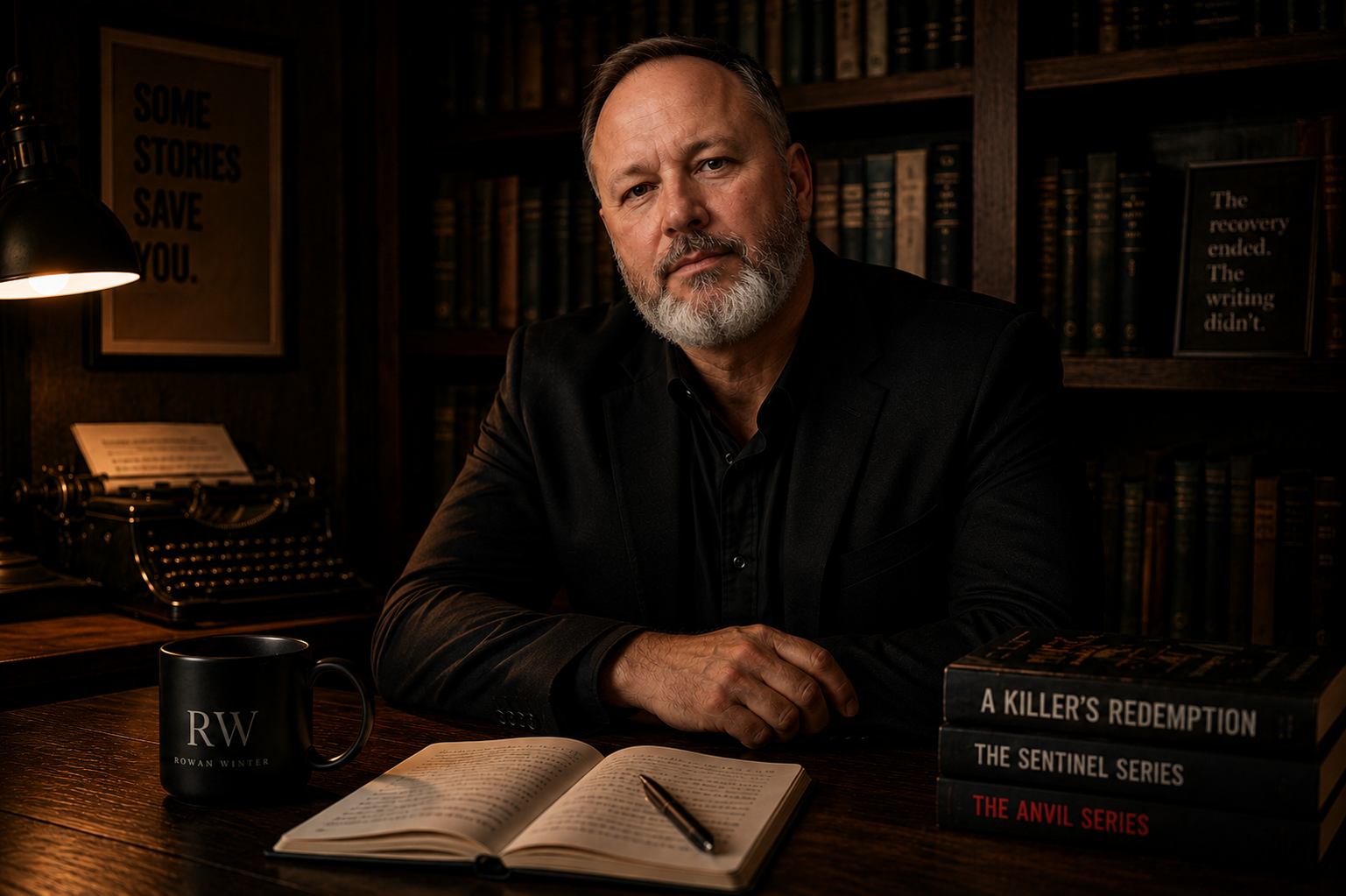
Rowan Winter writes psychological thrillers and dark suspense built on lived experience. The Blackwater Series began as a story about survival and became something much older and stranger along the way.
The writing started during a period of severe recovery, as a way through sleepless nights when nothing else helped. It never stopped.
Read the Full StoryContinue the Journey
The Becoming Is Here
Available now on Amazon. Start reading today.