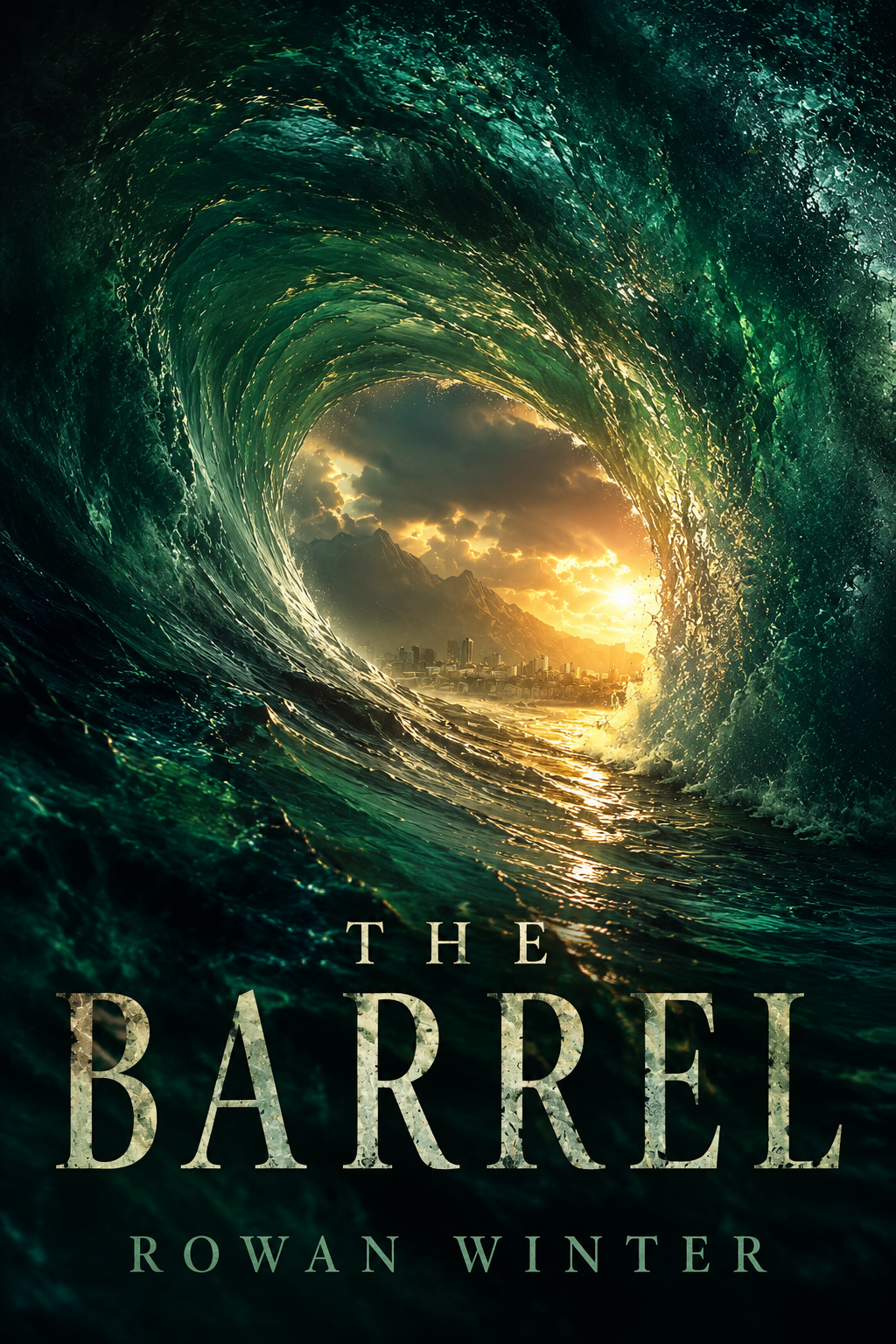
The Dead Water Series · Book One
The Barrel
Coming SoonShe drowned at twelve and came back wrong.
Now her brother has disappeared at a wave that should not exist.
The Dead Water Series · Book One
She drowned at twelve and came back wrong.
Now her brother has disappeared at a wave that should not exist.
The Story
SHE CAME BACK FROM DROWNING. HER BROTHER DIDN'T. NOW SHE HAS TO GO BACK IN.
Maya is a skip tracer working out of Miami — the best in the business, because she has a shortcut no database can replicate. When she sleeps with someone, their secrets pour out involuntarily. Every confession, every buried truth, every name they've never said aloud. She finds people who don't want to be found. She takes her fee. She drinks until the hollowness stops echoing. She calls it a living.
It started when she was twelve. A riptide off Virginia Beach held her under for four minutes. She came back, but the thing that should have been inside her didn't. Into that emptiness, like water finding a channel, came the compulsion. She's spent twenty-two years treating it as a tool and trying not to think about what it cost her.
Five years ago, her brother Danny disappeared. A marine biologist and big-wave photographer, he went to shoot a legendary surf break off the Central American coast — a wave called The Barrel, a perfect, deadly tube that forms only a dozen times a year. His surfboard washed up. His body never did. The official story said wipeout. Maya had been too destroyed to question it.
Then she opens his storage unit and finds a waterproof drive hidden inside a surfboard fin, taped there with marine-grade adhesive. A note in Danny's handwriting: For Maya. If you're reading this, I'm sorry. Don't trust the water. Don't trust the ones who come back different. Find the Barrel.
The man she finds at the end of the trail — Cole, in his fortress of glass and teak above the volcanic cove — is wearing humanity like a well-tailored suit. Patient. Ancient. Cold. And the water beneath his house knows her name.
Maya has spent her whole life running from the ocean. Now the ocean is the only place left to look.
The Barrel is a supernatural thriller about grief, compulsion, and what waits for us in the water below.
For fans of Paul Tremblay, Stephen Graham Jones, and Carmen Maria Machado.
The Dead Water Series
The Series So Far
Two books. One story of what the water gives back, and what it expects in return.
Book One
The Barrel
Coming SoonBook Two
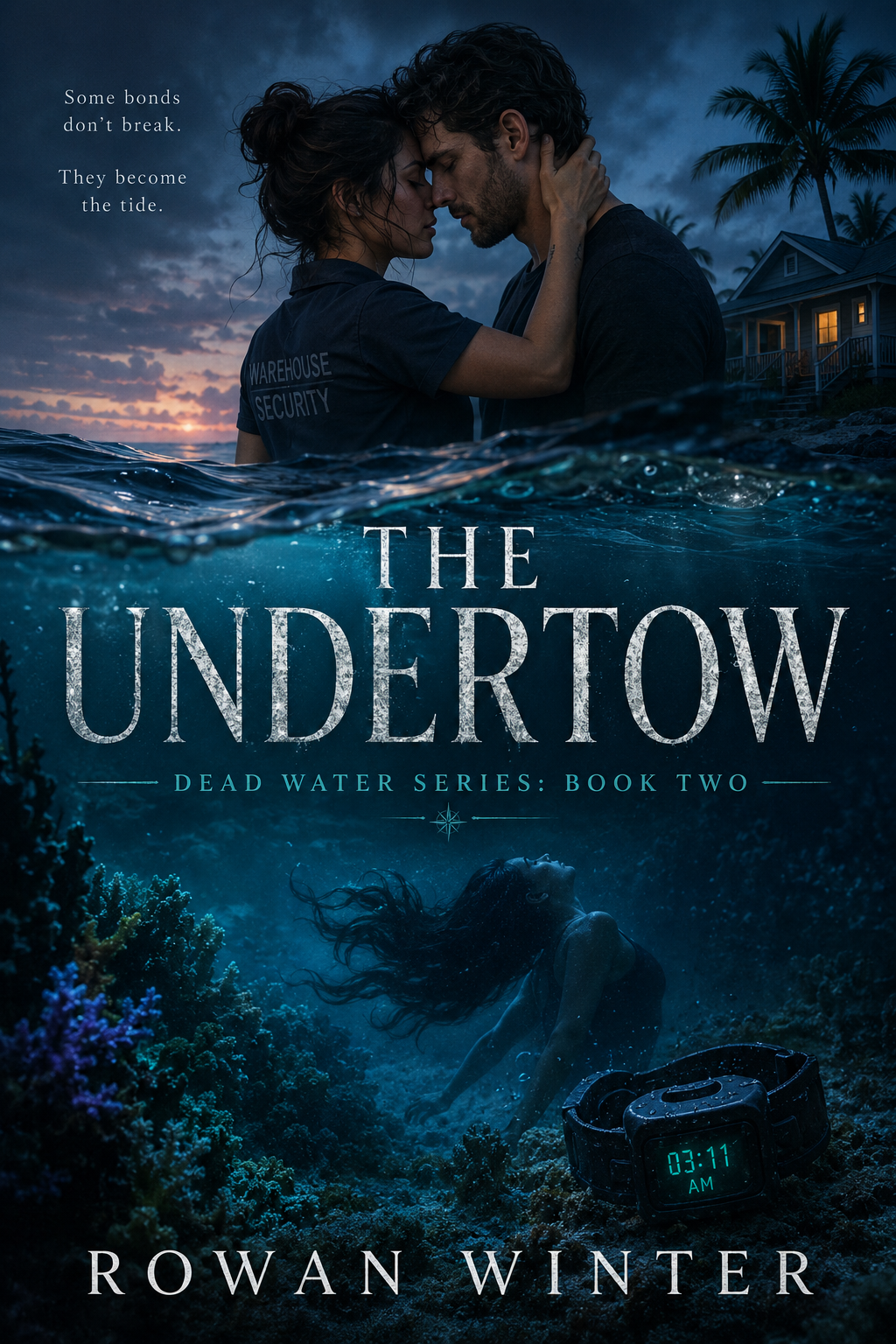
The Undertow
Coming OctoberWhat to Expect
A Protagonist Who Is the Problem
Maya's ability is not a gift. It's a theft. She knows this. She does it anyway. The book never lets her off the hook — and neither does she. What makes her compelling is that she knows exactly what she is.
Brother and Sister at the Core
The mystery is the engine. The grief is the fuel. Danny was the only person who knew what Maya was and stayed anyway. Finding out what happened to him is the first real thing she's wanted in years.
The Ocean as Threat
The water isn't a setting. It's a presence. It called to Maya when she died in it, and it has never stopped. The Barrel — the wave, the place, the thing — is where all of it converges.
An Antagonist Who Fits Too Well
Cole is patient, charming, and ancient. He does not feel rushed. He is wearing something human because it is convenient. The horror of him is not what he does — it's what he is, and how long he has been it.
Investigation With Teeth
The skip-tracer structure keeps the plot moving — every chapter is a lead, a door, a thread pulled. But the investigation is headed somewhere the genre doesn't usually go, and once it gets there, it does not come back the same.
The People Inside the Story
Protagonist
Maya
Skip tracer. Bloodhound. The best at finding people who don't want to be found, because she has a shortcut no one else does. She drowned at twelve and came back hollow. The compulsion moved into the emptiness. She's been using it as a tool and trying not to count the cost ever since.
The Missing
Danny
Maya's brother. Marine biologist, big-wave photographer, believer in the ocean's mysteries. The only person who knew exactly what she was and never treated her like a ghost. He disappeared at The Barrel five years ago. His surfboard came back. His note says: don't trust the ones who come back different.
The Antagonist
Cole
A man in a glass fortress above a volcanic cove, barefoot, charming, apparently at ease. The resonance hits Maya the moment she steps across his threshold: ancient, patient, cold. He is wearing humanity like a well-tailored suit, and he has been wearing it for a very long time.
The Elder
Rosa
An old woman who crosses herself out of habit and says things she shouldn't know. "You have the smell of someone walking to their own funeral." She is the kind of person who has lived long enough to stop being surprised by the things that live in the water. She is not always right. She has never been wrong about the important things.
Be First to Know
The Barrel is coming. Follow along and you'll be the first to know:
Free Sample
Free First Chapter
The man was crying.
Not the ugly kind, not yet. The preface—his breath hitching, his eyes glassy, his hand still tangled in the sheet where her hair had been, like he didn't know whether to reach for her or cover his face. Maya knew the look. She'd seen it on dozens of faces, in dozens of cheap rooms, in dozens of cities that all smelled the same: bleach and desperation and the particular musk of someone who'd just told the truth for the first time in years.
"Her name was Elena," he whispered. "My daughter. She's eight. I haven't seen her in—"
"Eleven months," Maya finished. She sat up, the sheet falling away, and reached for her cigarettes on the nightstand. The motel room was Miami at its most honest: water stains on the ceiling, a Bible with a broken spine, a window that rattled in the humidity even when it was closed. "You told me. You told me everything."
She lit the cigarette and didn't look at him. Couldn't. The compulsion was fading now, the post-coital haze where their minds unlinked, where the truth stopped pouring out of him and she stopped being the vessel that received it. He'd be confused in an hour. Ashamed in two. By morning, he'd convince himself he'd been drunk, that he'd said nothing, that the strange woman with the dead eyes hadn't pulled his darkest secrets out through his cock like a magician pulling scarves from a sleeve.
Maya had stopped finding it impressive a long time ago.
"You're not—" The man struggled to sit up, the sheet pooling at his waist. He was fortyish, soft in the middle, a wedding ring tan line he'd tried to hide by switching hands. A shipping logistics manager. That was what she'd wanted. Not him. His access. His manifests. "You're not going to—"
"Tell anyone?" Maya exhaled toward the window. The neon from the strip mall next door bled through the blinds, painting her skin in stripes of pink and green. She looked like a crime scene. Felt like one. "No. I got what I needed. Go back to your wife. Call your daughter. Maybe mean it this time."
She dressed without hurry. Jeans, black tank, boots that had walked through worse than this. The man watched her, still crying, still touching himself like he could feel where she'd been inside his head. She didn't kiss him goodbye. She never did. That would require something she couldn't fake, and she was too tired to perform tonight.
The door closed behind her on his muffled sobs.
Outside, the Miami night was a wet blanket—August heat that made the air feel drinkable, the smell of Cuban coffee and exhaust and the ocean that was always too close. Maya walked to her car, a ten-year-old Civic with a cracked windshield and a trunk full of surveillance gear she told herself was for work. She didn't think about the man. She'd already filed his confessions: the shipping container numbers, the port schedules, the supervisor who took bribes to look the other way when certain containers moved through without inspection. She'd use it next week, maybe. Track someone who didn't want to be found. Collect her fee. Drink until the hollowness stopped echoing.
She was good at her job. Skip tracer, technically. Bloodhound, more honestly. She found people who'd buried themselves in new lives, new names, new marriages. She was better than the databases and the private investigators because she had a shortcut no one else had.
The problem was the price. The problem was always the price.
Her apartment was a third-floor walk-up in Little Havana, the kind of place where the roaches were brazen and the neighbors played bachata until 3 AM. Maya didn't mind the noise. The noise was company. She climbed the stairs, her legs heavy in a way that had nothing to do with the climb and everything to do with the man still crying in the motel room, the truth she'd taken from him, the emptiness where something like guilt should have been.
She'd drowned when she was twelve. Riptide off the coast of Virginia Beach. Pulled under, held down, lungs burning, the world going green and then black and then—nothing. Four minutes clinically dead. They'd brought her back, her mother screaming on the beach, her father praying in a language he'd forgotten until that moment. Maya had opened her eyes and looked at the paramedic and known, with the certainty of someone who'd seen the other side, that she was wrong.
Not broken. Not traumatized. Wrong.
The thing that should have been inside her—the soul, the spark, the whatever-you-called-it that made people human—hadn't come back with the rest. She was a house with the lights on and no one home. And into that emptiness, like water finding a channel, had come the compulsion.
She hadn't known what it was at first. She'd been twelve, then thirteen, then fourteen, discovering that boys who kissed her told her things they shouldn't. That men who touched her confessed secrets that ruined them. That every orgasm she gave was a transaction where she took more than she gave, where the pleasure was real but the intimacy was theft.
She'd tried to stop. For years. Celibacy, therapy, prayer, drugs. Nothing filled the emptiness. Nothing stopped the hunger. She'd learned to use it instead, to make it a tool, to tell herself that the people she slept with were bad anyway—cheaters, criminals, abusers—and that taking their truth was a kind of justice.
She didn't believe that anymore. She just didn't have an alternative.
Maya unlocked her door, kicked off her boots, went straight to the kitchenette. The bottle of rum was half-empty. She didn't pour a glass. She drank from the neck, two long swallows, waiting for the burn that would dull the edges. The hollowness was worse tonight. It always was after the compulsion. Like the emptiness had expanded to make room for someone else's truth, and now that truth was gone, leaving her more vacant than before.
Danny.
Her brother. Her anchor. The only person who'd known what she was and hadn't treated her like a ghost. He'd been a marine biologist, a big-wave photographer, a believer in the ocean's mysteries who approached them with data and wonder rather than darkness. He'd been the one who held her when she woke up screaming. He'd been the one who never needed the compulsion. He'd just known.
Five years ago, he'd disappeared. The Barrel. A legendary surf break off the Central American coast that appeared only under perfect conditions, a dozen times a year. His board had washed up. His body never had. The official story: wipeout, pulled into the trench, drowned. Maya had been too destroyed to investigate. Too drunk. Too empty. She'd let the case go cold because looking at it meant looking at the water, and looking at the water meant remembering what she'd seen in those four minutes of death.
The green. The depth. The door.
The storage facility was on the edge of the warehouse district, a concrete block with roll-up doors and a security guard who slept more than he watched. Maya went at 2 AM because she couldn't sleep, because the rum had stopped working, because the emptiness had grown teeth and was chewing at her from the inside.
The roll-up door screeched when she lifted it. The smell hit her first—neoprene and salt, the ghost of ocean that clung to everything Danny owned. She stood in the doorway, breathing it in, feeling the resonance stir in her chest like a muscle she hadn't used in years.
The unit was organized with Danny's characteristic precision—surfboards racked by size, wetsuits hung by thickness, waterproof bins labeled with dates and locations. She ran her hand along a board, feeling the fiberglass smoothness, the wax residue. Her fingers found something wrong.
A six-foot shortboard, the nose slightly dented, the rails worn. The fin box—the slot where the removable fin attached—felt rough. She knelt, peered closer. The fin was in place, but the box had been modified. Hollowed out. She worked the fin free, turned it over, and felt her breath stop.
A waterproof drive, no bigger than a thumb, taped inside the hollow with marine-grade adhesive. A note in Danny's handwriting, barely legible, preserved in a plastic sleeve:
For Maya. If you're reading this, I'm sorry. Don't trust the water. Don't trust the ones who come back different. Find the Barrel.
Maya sat on the concrete floor, the drive in her palm, the note shaking in her other hand. She stared at the line. Danny had been a surfer. He'd loved the water with a devotion she'd never understood. If he was warning her away from both, then something had changed—something fundamental, something that had made him fear his own people.
The resonance stirred again—that frequency she'd touched in death, the hollow place in her chest vibrating in answer. She hadn't felt it this clearly in years. Not since the drowning. Not since the door.
She found a laptop in one of the bins—Danny's old field computer, ruggedized, dead as stone. She searched the unit until she found the power adapter coiled behind a stack of waterproof cases, plugged it into a wall outlet Danny had apparently paid extra for, and waited. The charge light flickered, died, flickered again. She held her breath without meaning to. Two minutes. Three. The screen finally glowed, dim at first, then steady, the operating system loading with a sound like a held note releasing.
She plugged in the drive. Three files appeared, encrypted, the icons generic white pages. She didn't have the key. She didn't have the skill. But the fourth file was a video, unencrypted, waiting like a trap.
She clicked it.
The Author
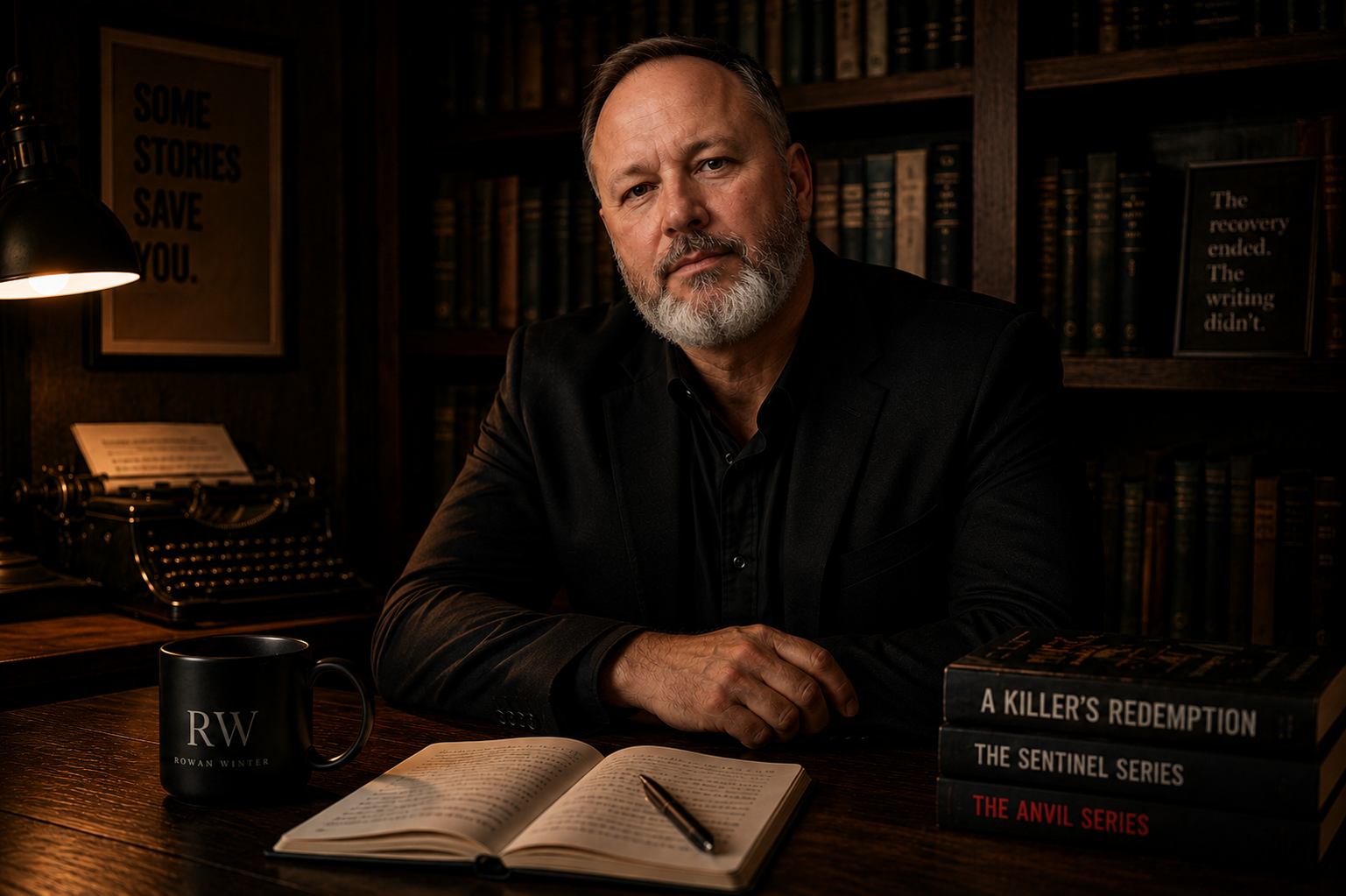
Rowan Winter writes psychological thrillers and dark suspense built on lived experience. The Sentinel Series draws from real law enforcement stories. The Blackwater Series explores the supernatural edge of what it means to survive. The Dead Water Series goes somewhere new: the place between drowning and coming back, and what waits there.
The writing started during a period of severe recovery, as a way through sleepless nights when nothing else helped. It never stopped.
Read the Full StoryWhile You Wait
The Blackwater Series and The Sentinel Series are available now.