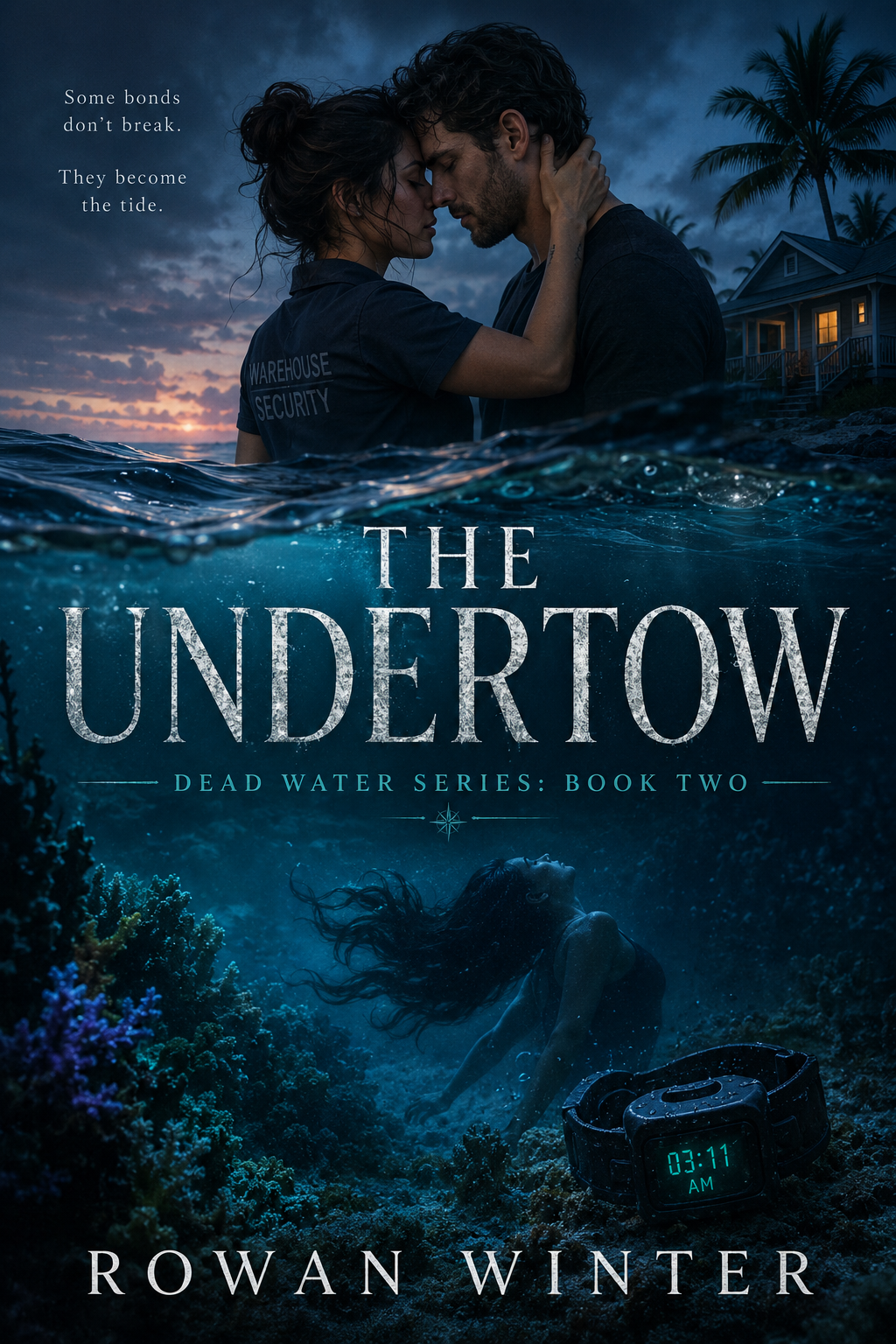
The Dead Water Series · Book Two
The Undertow
Coming in OctoberSome bonds don't break.
They become the tide.
The Dead Water Series · Book Two
Some bonds don't break.
They become the tide.
The Story
SOME BONDS DON'T BREAK. THEY BECOME THE TIDE.
Two years ago, Maya walked into a fortress of glass and teak above a volcanic cove looking for the man who took her brother. She found something else instead — a bond neither of them asked for and neither of them can undo.
Now she and Cole live an ordinary life on the coast: a bungalow with exactly one chair that doesn't wobble, a warehouse security job with nothing in it worth tracing, a coral nursery slowly growing back what the ocean lost. Two years of the same four words at the same broken hour of the night — I'm still here — carried down a link that was forged the night everything nearly ended, and has held, faithfully, ever since.
It should feel like enough. Most days, it does.
Then, on an ordinary morning after the best night either of them can remember, Maya feels it through the link: a skip. One dropped beat in a heart that has kept faithful, unnatural time for two years without complaint. Small enough to explain away. Small enough to let him sleep through. Small enough, almost, to pretend she didn't feel it at all.
She doesn't wake him. She tells herself that's kindness.
But the ocean that gave her back to the world once already isn't finished asking for a return on what it lent — and whatever still lives in the borrowed, unstable rhythm of Cole's heart hasn't forgotten what it's owed.
The Undertow is a supernatural thriller about the cost of an ordinary life earned the hard way — and what happens when the tide that built it starts, quietly, to pull back out.
For fans of Paul Tremblay, Stephen Graham Jones, and Carmen Maria Machado.
The Dead Water Series
What to Expect
A Different Kind of Fear
Book One was about surviving the water. Book Two is about what it costs to trust the peace on the other side of it — and what it feels like when that peace starts to crack.
The Link
A bond that carries sensation and knowing in both directions, no delay, nothing to hide behind. It's intimate and uncanny in equal measure — and it's the first thing to tell Maya something is wrong.
An Ordinary Life, Hard-Earned
A warehouse job. A coral nursery. An ankle monitor charging behind the toaster like it's furniture. The small, unremarkable details of two people who fought for the right to be boring — and know exactly what it cost.
The First Crack
A single skipped heartbeat, felt through a bond that has never once lied to her. The entire book's tension compressed into one small, deniable moment — and the choice to say nothing about it.
The Cold Remembers
Whatever bound them together in Book One has been quiet for two years. Quiet is not the same as gone — and what it lent Cole, it has never once forgotten it's owed back.
The People Inside the Story
Protagonist
Maya
Two years past The Barrel, Maya has traded skip-tracing for warehouse security and traded running from the ocean for glassy Sunday sessions with Cole. She still reads people's tells out of old habit. She still feels every one of Cole's heartbeats through the link they share. She has almost let herself believe that ordinary is allowed to last.
The Bond
Cole
Two years removed from whatever he was before the cove, Cole spends his days elbow-deep in coral tanks and his nights sleeping in a bed he no longer has to guard. The ankle monitor charges behind the toaster now, unremarkable as the toaster itself. He has almost let himself believe the Cold is done with him.
The Threat
The Cold
Not a person. Not entirely. The presence that watched Cole for fifteen years, that recorded everything as data, that lent him the borrowed, unstable heartbeat still ticking in his chest. It has been quiet for two years. Quiet was never the same thing as gone.
The Series So Far
Start from the beginning. The Barrel is Book One.
Book One
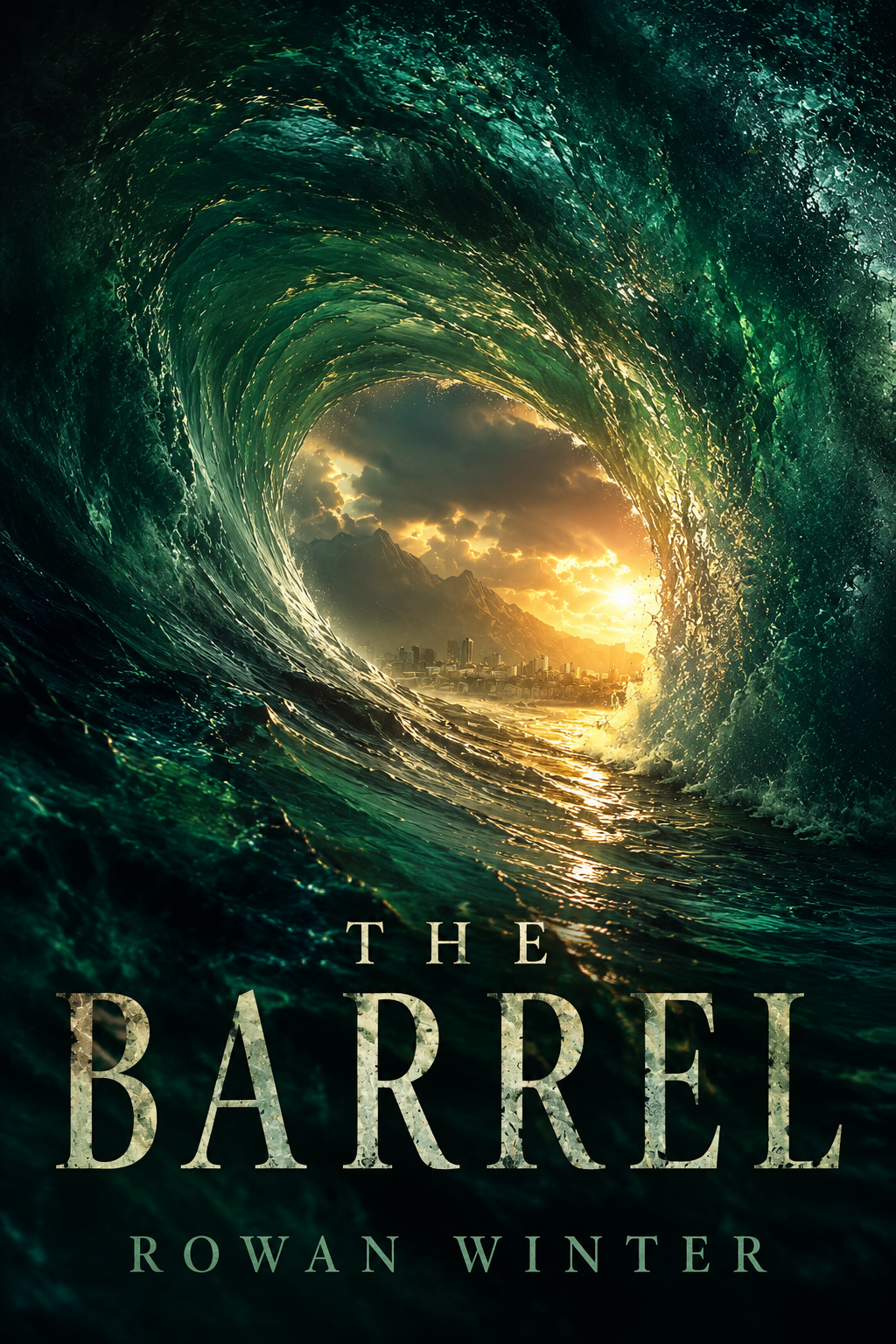
The Barrel
Coming SoonBook Two
The Undertow
Coming OctoberBe First to Know
The Undertow arrives in October. Follow along and you'll be the first to know:
Free Sample
Free First Chapter
Maya woke at 3:11 AM, the way she always did now, not from a nightmare but from the absence of one — some animal part of her brain doing a roll call before it would let her sleep again. The bungalow was dark except for the green numerals of the ankle monitor's charging dock blinking on the nightstand, patient as a heartbeat. The reggaéton next door had finally died sometime after midnight. The draft came in under the door the way it always did, carrying salt and the mineral cold of a coastline that had never once, in two years, been warm before dawn.
She didn't reach for him. She reached for the link instead, the way she'd reach for a light switch in a familiar room, and found him already awake, already turned toward her in the dark, his eyes open and catching what little light there was.
"I'm still here," he said.
"I'm still here," she answered.
It should have worn thin by now. Two years of the same four words at the same broken hour, said by two people who knew — who could feel, through the channel the blood ritual had carved permanently into both of them — that the other one's heart was still going. Cole's heartbeat lived in her chest now the way her own did, a second rhythm under the first, slightly off from hers, slightly wrong in a way she'd long since stopped noticing because it had become the sound of him being alive. It should have worn thin. It hadn't. Some rituals were like that — they got load-bearing instead of stale, holding up more weight the longer you used them.
She rolled into him anyway, because the ritual didn't require contact but she wanted it, and that wanting was still new enough to feel like a small, private miracle every time she indulged it. His arm came around her without him fully waking, an old reflex from a body that had spent fifteen years sleeping with one part of itself on watch. She put her hand flat over his sternum and felt it there — the actual physical thud against her palm, redundant with the one she felt in the link, two confirmations of the same fact, his heart keeping a time that wasn't quite its own.
Still here, she thought, not at him, just into the dark, a private amen.
They fell back asleep tangled together, and when the light came up gray and pink through the gap in the curtain, the alarm on his ankle monitor chirped its thirty-second satellite check-in, and the day began the way every day began now — ordinarily.
By seven she was in her uniform, gray polo with WAREHOUSE SECURITY stitched over the breast pocket in thread gone slightly stiff from cheap detergent, and she was eating toast standing up at the counter because the bungalow had exactly one chair that didn't wobble and Cole was sitting in it, working on his second cup of coffee with the methodical patience of a man who used to count minutes before a kill and now counted them before fieldwork that grew things instead.
"Tank four's ready for the new fragments," he said. "Koa sent measurements. Water's holding steady at twenty-six degrees, salinity's good."
"You say that like I know what good salinity is."
"You know exactly what good salinity is. You've been listening to me talk about parts per thousand for two years." He looked up, and the look had a warmth in it that still occasionally stopped her breath — not because it was rare, but because she still sometimes couldn't believe it was real, that a man could look at her like that without anything being extracted from her to earn it. "You're just being difficult because it's Sunday and you don't have to pretend to care about my coral today."
"I always care about your coral."
"You tolerate my coral."
"I love your coral the way I love a stray cat that lives in our yard. From a respectful distance, with reservations."
He laughed — a real laugh, low and easy, the kind that two years ago would have come out of him rusty, like a hinge that needed oil, and now came easy because he'd had two years of practice being a man who laughed at his own kitchen table. The ankle monitor's little box sat against the table leg, charging, its cord snaking up to the outlet behind the toaster, as unremarkable in their lives now as the toaster itself. He'd stopped flinching when people glanced down at his ankle in the grocery store. She'd stopped reaching for a weapon that wasn't there every time someone watched them a half second too long. They'd built something out of cheap materials and stubbornness, and on most days it held.
"Patrol till four," she said, swallowing the last of the toast dry. "Then I'm free. You said something about the water being good this weekend."
"Glassy. No wind till Tuesday." He said it carefully, watching her, the way he always did when he offered her the ocean, like he was still checking, after two years, whether the offer would land as a gift or a test. It used to be a test. Some part of her — the twelve-year-old who'd been four minutes dead in a riptide off Virginia Beach — had spent twenty years flinching from open water like it was a hand reaching up out of the dark to finish the job. That part of her was quieter now. Not gone. Quieter.
"Glassy sounds good," she said, and meant it, and watched something in his shoulders ease that had nothing to do with the link and everything to do with twenty years of her learning, slowly, to mean things.
The warehouse shift was the kind of boring that Maya had come to treasure with an intensity she didn't examine too closely. Forty thousand square feet of palletized inerts — bath fixtures, mostly, crated porcelain bound for hotel renovations up and down the coast — and her job was to walk the perimeter every two hours with a flashlight she didn't need in daylight, check that the bay doors were locked, log the temperature in the climate-controlled section, and otherwise exist in a building where nothing was trying to kill her, recruit her, or drown her.
She'd been a skip tracer once. A bloodhound. She'd found people who'd spent considerable money and cunning trying not to be found, and she'd done it by learning to read the small tells of a life built over a hidden one — the slightly-too-careful explanation, the gap in a story where a name should be. Those instincts didn't turn off just because the work had gotten boring. She caught herself, twice a shift on average, running a skip trace on absolutely nothing — clocking the make and model of a car idling too long near the gate, noting that the new temp in receiving favored his left hand when he wrote but his right when he lifted, filing it away under a heading her brain still kept, two years on, marked SUSPICIOUS, USE LATER.
There was nothing to use it on. That was the point. That was supposed to be the point.
At 11:40 she did her walk of the south perimeter and the link gave her a small flare of something — not alarm, just texture, Cole's attention sharpening somewhere thirty miles up the coast. She didn't worry. She filed it as nothing and kept walking, and by the time she clocked out at four the flare had faded back into the low hum that was just Cole, just the baseline frequency of him existing in the world at the same time she did.
She drove to the reef site to pick him up, the secondhand Civic with one functioning AC vent rattling over the coast road the same way every rental car in her life seemed required to rattle. Koa's three-site network had grown enough that this particular nursery had its own modest building now, cinder block and corrugated roof, tanks humming under grow-lights that mimicked the wavelength of shallow tropical water. Cole was at the big tank, shirtless, soaked to the waist, his hands underwater with the same terrible precision she'd once watched him use to handle a knife. He didn't hear the car. He felt her arrive — she felt him feel it, a small brightening in the link like a window catching sun — and he looked up and smiled before he turned around.
"Glassy," he said, by way of hello, holding up his wet hands. "I checked twice."
"You're easy to please."
"I'm exactly as hard to please as I've always been. You're just better at it now."
They surfed the late afternoon, an ordinary break twenty minutes south of the bungalow, three-to-four-foot lines peeling left under a sky going the color of a bruise healing — purple shading into gold. There were two other people in the water, a father teaching his daughter to pop up on the inside, their laughter carrying thin and bright across the channel. No Barrel. No green light under the surface. No hunger in the water at all, just water, doing what water did when nothing ancient was watching it.
Maya caught three waves and fell off two of them on purpose, just to feel the tumble, the harmless violent comedy of being upside down in three feet of whitewater with nothing underneath her but sand. She came up laughing, hair plastered over her face, and paddled back out to where Cole sat waiting on his board past the breakers, watching her with an expression she'd once have called dangerous and now just called his.
"You're doing it on purpose," he said. "Falling."
"It's fun."
"It used to terrify you. Being upside down in moving water."
"It still does, a little." She pulled herself up onto her board, straddling it, salt water sheeting off her shoulders. "That's why it's fun now. Used to be the whole ocean was a hand trying to finish what it started when I was twelve. Now it's just — water that knocks me over sometimes." She shrugged, and the shrug was easy, unweighted, a sentence she could finally say all the way to the end without her chest closing on the last word. "Ordinary water."
The sun was dropping toward the horizon, throwing a long bronze road across the swell, and the other surfers had gone in, calling thanks to the lifeguard tower, gear bags slung over shoulders, the ordinary end of an ordinary day. The channel between the peaks went quiet and gold and theirs.
Cole paddled closer, until their boards bumped, until his hand found her ankle under the water — not the monitored one, the bare one, the one with the old pale scar from a Virginia Beach riptide twenty-two years gone — and held it there, his thumb tracing slow over the scar tissue like he was reading braille.
"What," she said, but she already knew what, because the link had gone warm and low and unmistakable, a frequency she'd learned the precise shape of over two years of mornings and motel rooms and a bungalow bed that sagged in the middle and forced them together.
"Nothing," he said. "Just looking at you."
"You're touching me."
"That too."
"Here?" she said, glancing toward the empty beach, the empty channel, the sun low enough now that the water had gone the deep burnished color of old pennies.
"Here," he said, and pulled her board against his, and kissed her with salt on both their mouths.
— — —
For a long moment neither of them moved. The boards drifted, tethered by their leashes, turning slowly in the current. The sun had gone below the headland, leaving the sky a deepening violet, the first stars showing faint behind it. Somewhere down the beach a dog barked twice and went quiet. Maya lay against Cole's chest, still joined to him, still tangled in the rocking boards, and felt — for the first time she could remember in this exact configuration — entirely, uncomplicatedly happy. Not relieved. Not grateful in the desperate way gratitude used to come to her, the way you're grateful for not drowning. Just happy, the ordinary, undramatic kind, the kind that didn't need an antecedent disaster to make sense of itself.
"We should go in," she said eventually, not moving. "It's getting dark."
"In a minute."
"You always say in a minute."
"And we always eventually go in." He pressed his mouth to her temple. "I like the minute, though. I like all the minutes."
They drifted a while longer before disentangling, dressing back into wet rashguards with the clumsy laughter of two people who'd done this before and would do it again, and paddled the boards toward shore on their stomachs, side by side, matching strokes without trying to.
They didn't make it back to the bungalow.
The beach was empty, the tide line marked with kelp and the bleached architecture of old driftwood, and they pulled the boards up past the high-water mark and lay down on them in the cooling sand, not deciding to stay so much as failing to decide to leave. Cole spread his rashguard out as a thin blanket against the sand and she curled into the curve of his body, her back to his chest, his arm heavy and warm across her ribs, and they watched the stars come out fully — more of them than the city sky over Miami had ever shown her in her whole drowned life, an absurd unnecessary number of stars, as if the universe had decided, after everything, to be generous.
"Tell me something true," she said, the old game they'd started in the motel room two years ago, the one that had replaced every other way of falling asleep.
"True." He was quiet a moment, his thumb moving slow against her hip. "I used to think I didn't deserve a night like this. Ordinary. Earned. I used to think the Cold would never let me have it — that every good hour was borrowed against some bill that was going to come due."
"And now?"
"Now I think maybe some of it's just — mine. Ours. Not owed to anything." His breath stirred her hair. "Your turn."
She thought about it, watching a satellite — or maybe just a plane — crawl steadily across the dark. "I used to think wanting things was how I got found out. That if I let myself want something badly enough, the compulsion would reach for it and ruin it before I even understood what I had. So I learned not to want. Out loud, anyway." She turned her face up toward him, found his eyes already on her in the dark. "I want this. I want you. Out loud. I'm not scared of saying it anymore."
He kissed her, soft, unhurried, salt-rough and certain, and they fell asleep like that, tangled on two surfboards and a thin rashguard with the sand cooling beneath them and the tide creeping up to whisper at their feet and retreat, whisper and retreat, all night long, patient as a held breath.
Maya woke first, the way she usually did, to gray light and gulls arguing somewhere down the beach and sand crusted in the crease of her elbow. The fire they hadn't built had never been needed — the night had stayed warm, the wind calm, the whole sky now washing slowly from slate to the soft, shell-pink of early morning. Cole slept beside her, one arm still slung over her waist, his face slack and unguarded in a way it almost never was awake, the lines around his eyes smoothed out, looking — not young, the Cold had taken that word's meaning from him fifteen years ago and never quite given it back — but at peace. At rest. A man, not a deal, not a debt, not a documentary cover story. Just Cole, asleep on a beach with sand in his hair, because he'd chosen, last night, to stay.
She lay still, not waking him, just feeling him through the link the way she did every morning, a habit so old now it didn't even register as a habit anymore, just the first thing her mind did on waking, the way some people checked a phone. His heartbeat. His breath. The low contented quiet of a sleeping mind with nothing urgent pressing on it.
And then — so small she almost let it go, almost filed it under the general static of being alive — she felt it.
A skip.
Not a flutter, not a missed beat exactly, more like a single frame dropped out of a film reel, a beat that should have landed and instead left the barest hitch of silence before the next one caught up to cover for it. She went very still, listening harder, the way she'd learned to listen to her own pulse in the dark when she was twelve years old and freshly hollowed and terrified of every sound her body made. The rhythm steadied. Resumed. Beat, beat, beat, ordinary as the tide.
She told herself it was nothing. Bodies skipped beats. Human bodies did it all the time, completely without consequence — too much caffeine, bad sleep, a dream that spiked adrenaline and then let it go. Cole's heart wasn't entirely human, hadn't been for fifteen years, but it had held a borrowed, unstable rhythm faithfully for two years now without complaint, the Cold's echo doing its strange patient work in the muscle of him, sustaining without explaining, the way it always had. One skip meant nothing. One skip was the kind of thing she wasn't even sure she'd actually felt, half-asleep, salt-crusted, still drunk on the night before.
She didn't wake him to ask. She told herself that was kindness — let him sleep, let the morning stay soft a little longer — and didn't examine the other reason underneath it, the one that didn't want to hear him confirm it, didn't want the ordinary morning to have to make room for anything that wasn't ordinary.
The gulls kept arguing. The tide kept its patient, retreating whisper. Somewhere up the beach a dog that wasn't theirs barked once at the rising sun.
Cole stirred against her, not waking fully, and murmured something into her hair that might have been her name, and his arm tightened around her waist with the simple unconscious reflex of a man holding onto something he didn't want to lose even in his sleep. She let herself be held. She matched her breathing to his, the way she always did, until she couldn't tell, the way she always couldn't, where the rhythm in her chest ended and the one in his began.
Still here, she thought, sending it down the link without words, the way she sometimes did when she didn't want to wake him but wanted the message delivered anyway.
The answer came back — warm, half-conscious, wordless — but not instantly. A microsecond's delay, so slight she might have imagined it, the barest echo of that skipped frame catching up to itself.
Still here.
She watched the sun clear the headland and turn the wet sand to a sheet of hammered gold, and she did not think about the skip again. Not yet. Not on a morning this ordinary, this earned, this much exactly what she had spent twenty years not believing she would ever get to have.
But she would think of it later. She would think of it every morning after, the way you think of the first hairline crack in glass you didn't know could break — small, almost nothing, easy to miss, and then, once you've seen it, impossible to stop seeing.
For now, she just held on, and let the tide keep time for both of them.
The Author
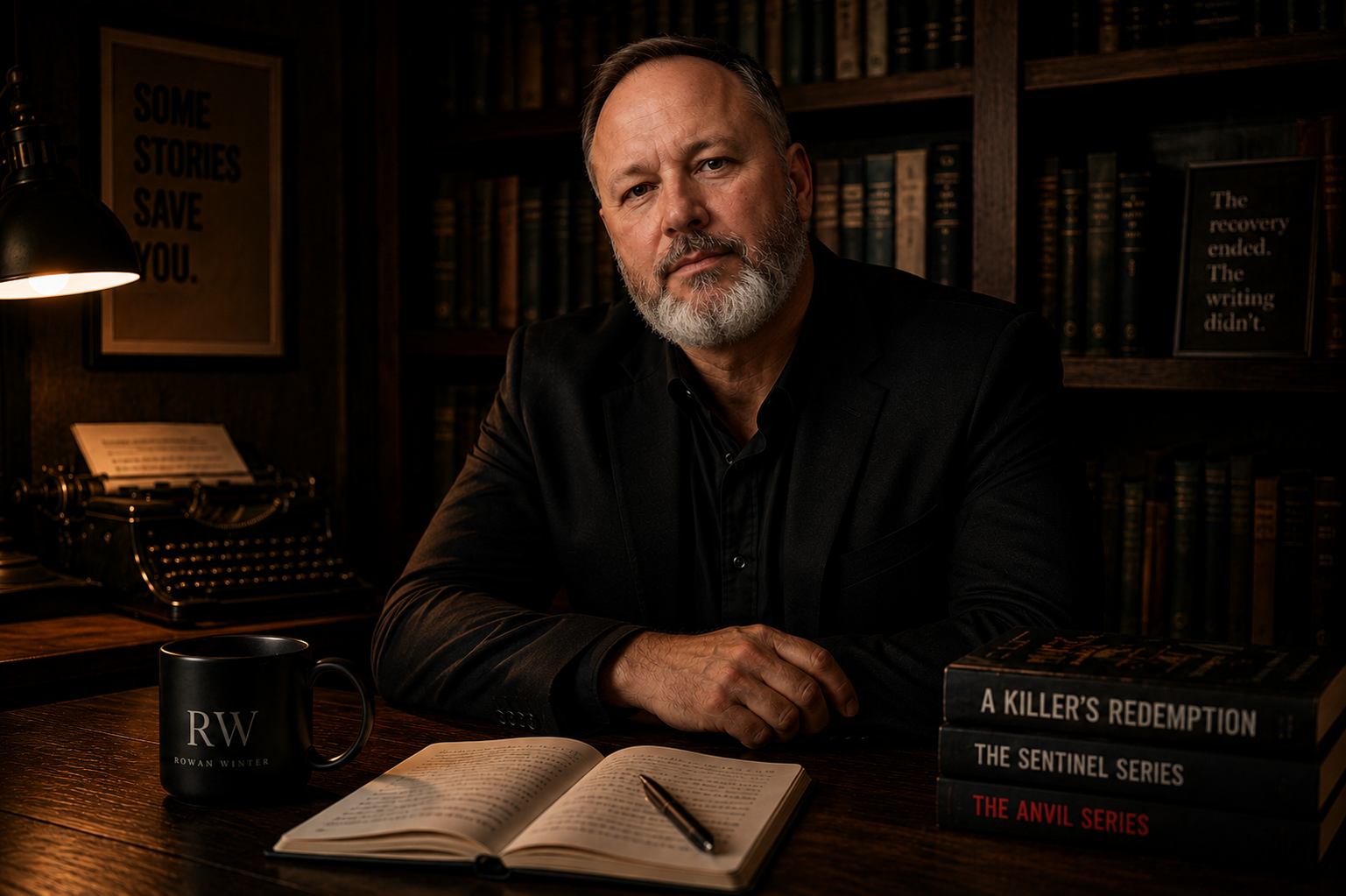
Rowan Winter writes psychological thrillers and dark suspense built on lived experience. The Sentinel Series draws from real law enforcement stories. The Blackwater Series explores the supernatural edge of what it means to survive. The Dead Water Series goes somewhere new: the place between drowning and coming back, and what waits there.
The writing started during a period of severe recovery, as a way through sleepless nights when nothing else helped. It never stopped.
Read the Full StoryWhile You Wait
The Blackwater Series and The Sentinel Series are available now.